
Hong Kong Anti DDoS Server: Why Bandwidth Alone Fails Gaming Logic
The most common advice for solving server instability is actually making it worse. When game servers lag or crash during peak hours, standard IT logic suggests upgrading the uplink port. Add more gigabits. Widen the pipe. But for a multiplayer environment facing modern threats, this approach is fundamentally flawed. It is like trying to fix a poisoned water supply by simply pumping more water through the pipes.
For gaming operations managers targeting the Asian market, finding reliable anti ddos hosting for multiplayer games is critical. The real enemy is not just the volume of traffic, but the purity of that traffic. A professional Hong Kong Anti DDoS Server is not just a hosting environment with a larger cable; it is a filtration plant designed to separate legitimate player actions from malicious noise without adding latency. If your strategy relies solely on capacity rather than a specialized dedicated server with ddos protection, your player base will leave long before your bandwidth cap is reached.
The Root Cause: Why “More Capacity” Fails
Traditional mitigation relies on absorption. The theory is simple: if the attack is 10Gbps and your port is 20Gbps, you survive. However, this logic fails in the real world of low-latency gaming, which is why a specialized Hong Kong Anti DDoS Server is necessary.
First, congestion creates jitter. Even if the pipe is not 100% full, a flood of garbage packets forces your network stack to process thousands of invalid requests per second. The CPU interrupts rise. The queue depth increases. For a player in Bangkok connecting to a Hong Kong Anti DDoS Server, this ensures stability prevents rubber-banding. Without it, the server is online, but the game is unplayable.
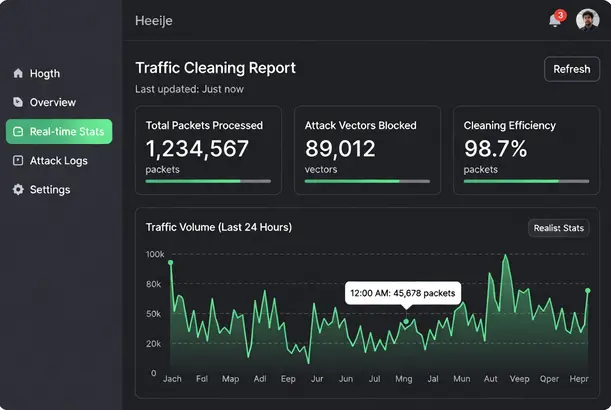
Second, many attacks today are not volumetric. Resource exhaustion attacks, or “Low and Slow” methods, target the application layer. They send small, complex requests that look legitimate but lock up server threads. A standard 100Gbps port is useless if the attack only needs 50Mbps to crash the game logic engine. This is where the Hong Kong Anti DDoS Server architecture differs.
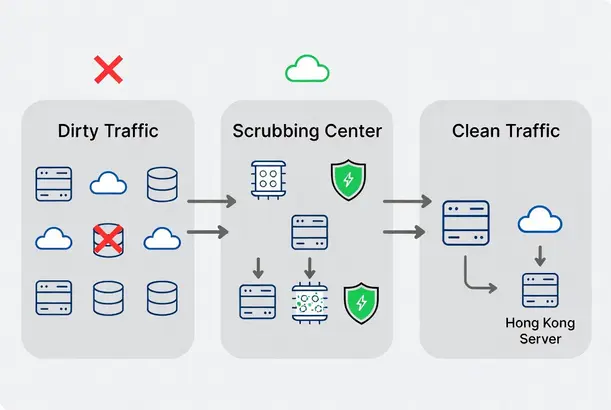
We approach this differently. Instead of a thick wall, our Hong Kong Anti DDoS Server deploys a smart gate. The objective is to identify the unique signature of attack traffic—malformed packets, invalid TCP flags, repetitive patterns—and discard them at the edge of the network.
Performance Data: The Clean Pipe Advantage
The geographic advantage of Hong Kong is its proximity to mainland China, Southeast Asia, and Japan. However, adding DDoS protection often routes traffic through distant scrubbing centers (e.g., in the US), adding hundreds of milliseconds of latency. This is unacceptable for gaming and defeats the purpose of a low latency gaming server Asia deployment.
Our infrastructure keeps the scrubbing local. By utilizing a native Hong Kong scrubbing center, we clean the traffic within the region to ensure the path remains direct. This allows our Hong Kong Anti DDoS Server to maintain elite performance speeds. Below is a comparison of latency performance during a simulated volumetric attack.
| Origin City | Standard IP (Under Attack) | Protected Clean Pipe |
|---|---|---|
| Singapore | 215.4ms (High Jitter) | 34.2ms |
| Manila | 189.8ms | 28.7ms |
| Shanghai (CN2) | Impacted / Timeout | 42.1ms |
Verifying the Path
Route stability is just as vital as speed. When protection kicks in on a Hong Kong Anti DDoS Server, the route must not fluctuate wildly. A stable route ensures that the variance in ping (jitter) stays below the threshold of human perception.
Tracing route to hk-game-node-04 [Protected IP]...

1  10.50.0.1 (Local Gateway)  0.4ms
2  202.14.xx.xx (ISP Edge)    2.1ms
3  129.22.xx.xx (Scrubbing Ingress)  30.5ms
4  10.200.5.1 (Cleaning Cluster)     30.8ms
5  10.200.5.5 (Clean Egress)         31.0ms
6  103.xx.xx.xx (Destination Server) 31.2ms

Trace complete. (Zero packet loss observed)
Notice the minimal delay between ingress (hop 3) and egress (hop 5). The cleaning process within the Hong Kong Anti DDoS Server ecosystem adds less than 1ms of overhead, preserving the competitive integrity of the gaming experience.
Beyond the Pipe: Layer 7 Precision
Volumetric attacks are loud; application attacks are quiet. A sophisticated attacker will not try to jam the door; they will try to confuse the receptionist. In a gaming context, this might look like a flood of login requests or UDP packets mimicking player movement data. This is why standard firewalls fail where a Hong Kong Anti DDoS Server succeeds.
Defending against this requires granular inspection. Our system analyzes the payload of the packets, not just the headers. It distinguishes between a player frantically clicking a mouse and a bot script sending 500 actions per second, utilizing advanced UDP flood protection HK protocols.
- Protocol Verification: We ensure that incoming packets strictly adhere to the game’s expected protocol (e.g., specific UDP ports for voice chat vs. game state).
- Behavioral Analysis: The Hong Kong Anti DDoS Server learns the baseline traffic profile. A sudden 5000% spike in requests to a specific lobby server triggers immediate, surgical mitigation rules.
- Zero False Positives: In gaming, blocking a real player is as bad as letting an attacker in. Our heuristic algorithms prioritize the retention of legitimate sessions on the Hong Kong Anti DDoS Server.
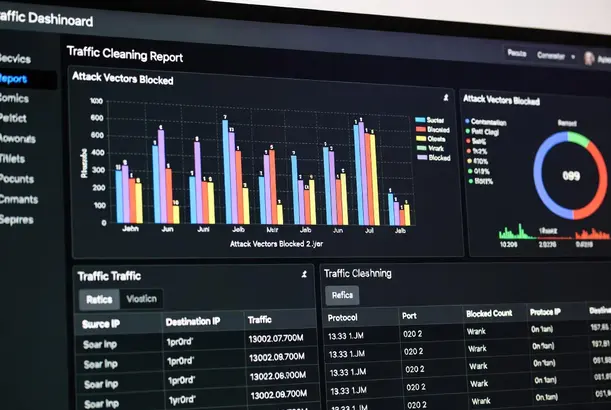
This level of defense allows you to run open services without fear. You do not need to hide your IP or rely on complex VPN setups for your users. You simply publish the endpoint, and the Hong Kong Anti DDoS Server infrastructure handles the hygiene.
Conclusion: Stability is Retention
Players do not quit games because of graphics; they quit because of frustration. A server that lags every time a rival clan decides to launch a booter script is a server that will soon be empty. The cost of a proper Hong Kong Anti DDoS Server is a fraction of the marketing budget required to acquire those lost users.
Shift your focus from raw bandwidth to intelligent filtration. By securing a clean, low-latency path into the heart of Asia with a robust Hong Kong Anti DDoS Server, you are not just protecting hardware. You are protecting the user experience, the community, and ultimately, the revenue stream of your title.
Secure Your Player Experience
Don’t wait for the next tournament crash to upgrade your defense. Test our low-latency scrubbing with a dedicated Proof of Concept for your game logic.
Deploy Hong Kong Anti DDoS ServerFrequently Asked Questions
How does a Hong Kong Anti DDoS Server affect game latency?
Our local scrubbing center used by the Hong Kong Anti DDoS Server adds less than 1ms of processing time. Because we filter traffic regionally rather than re-routing it to the US or Europe, players in Asia experience no perceptible increase in ping.
Can this server handle UDP floods common in gaming?
Yes. Our Hong Kong Anti DDoS Server infrastructure is specifically tuned for UDP traffic profiles. We incorporate specialized UDP flood protection HK modules to distinguish between legitimate high-frequency UDP game packets and malicious floods.
What happens if the attack exceeds the bandwidth capacity?
We utilize a massive global Anycast network to absorb volumetric attacks at the source. Only clean traffic is forwarded to your Hong Kong Anti DDoS Server, meaning your local uplink never gets saturated regardless of attack size.
Do you support custom mitigation rules on the Hong Kong Anti DDoS Server?
Absolutely. We understand that every game engine is unique. Our team works with you to define specific TCP/UDP flow rules and whitelists to match your proprietary protocols on your Hong Kong Anti DDoS Server.
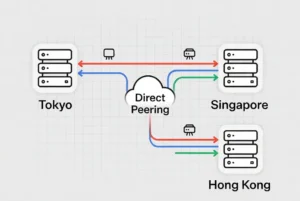
Is this suitable for Mainland China players?
Yes. A Hong Kong Anti DDoS Server is the optimal bridge for Mainland China connectivity. Our servers utilize direct peering routes (such as CN2 GIA where applicable) to ensure low latency and minimal packet loss for cross-border players.