
Tokyo Dedicated Server Hosting: Solving the Cloud Latency Trap
Scaling your game servers on the public cloud might be the single biggest technical mistake you are making this year. It sounds efficient on paper. Infinite elasticity. Pay-as-you-go pricing. But for real-time applications like competitive gaming or high-frequency trading, this convenience comes with a hidden, performance-killing tax. The virtualization layer itself is introducing unpredictable micro-stutters that no amount of code optimization can fix. This is where Tokyo dedicated server hosting becomes the essential infrastructure choice.
When a player in Singapore misses a critical shot in your Tokyo-hosted match due to a sudden jitter spike, they do not blame the hypervisor. They blame your game. They churn. This article challenges the industry default of cloud-first deployment for session-based workloads. We argue that Tokyo dedicated server hosting remains the superior architectural choice for delivering the consistent, jitter-free experiences your Asian user base demands.
The Overlooked Root Cause: Virtualization Noise
Why do perfectly optimized game engines still suffer from rubber-banding? The answer often lies in the noisy neighbor effect. On a public cloud, your game server instance shares physical resources with dozens of other tenants. A database backup running on a neighbor instance can saturate the L3 cache or memory bandwidth, causing your process to stall for milliseconds. In a turn-based strategy game, this is invisible. In a first-person shooter requiring 128-tick updates, it is catastrophic.
Tokyo dedicated server hosting removes this variable entirely. You are not renting a slice of a CPU. You are controlling the physical chassis. This provides hardware determinism. Input A always results in Output B within a guaranteed timeframe. There is no hypervisor stealing cycles for management tasks. There are no neighbors fighting for I/O. For an Operations Lead preparing for a major season launch, this isolation transforms infrastructure from a liability into a competitive asset.
| Metric | Standard Public Cloud | [Product Name] Bare Metal |
|---|---|---|
| CPU Steal Time | Variable (0.5% – 5%) | 0% (Guaranteed) |
| Network Jitter (Peak) | 12ms – 45ms | < 1ms |
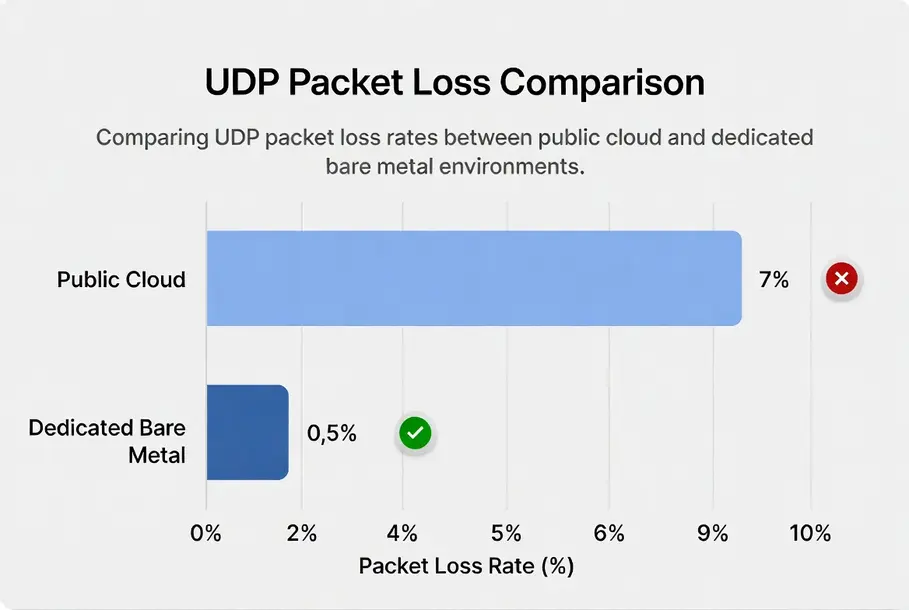
| UDP Packet Loss | 0.5% – 2.0% | < 0.01% |
Tokyo Dedicated Server Hosting: Stabilizing the APAC Corridor
Geography is the other half of the latency equation. Tokyo serves as the digital anchor for the entire Asia-Pacific region, making it the prime location for APAC gaming server hosting. However, physical location alone is insufficient if the network routing is suboptimal. Many providers route traffic through congested public exchanges to save costs. This results in the dreaded peak-hour lag that floods support tickets.
Direct Peering Advantage
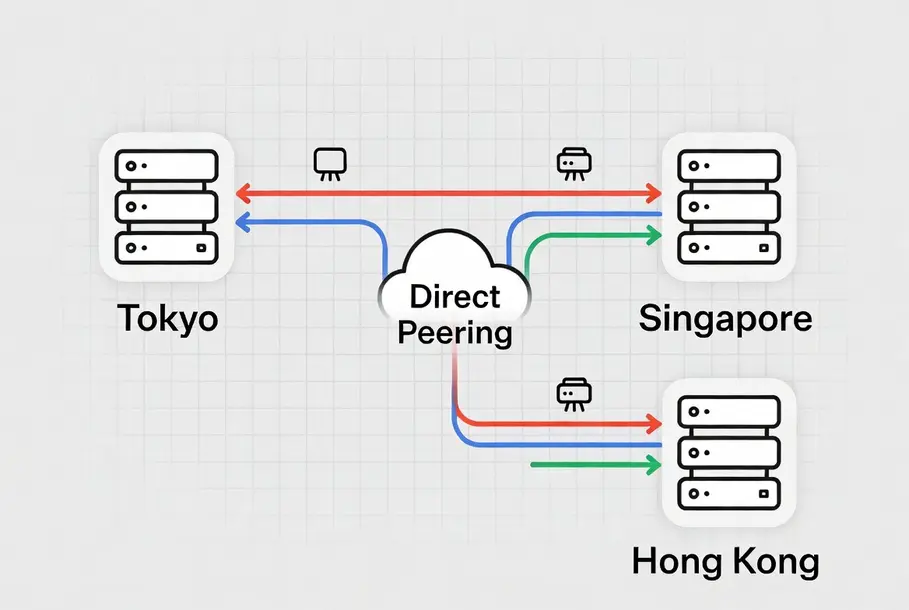
Our Tokyo dedicated server hosting infrastructure prioritizes quality of service over lowest-cost routing. By peering directly with major exchanges like JPIX and BBIX, we flatten the path between your server and the player’s ISP. We bypass the congested public internet hops where packet loss most frequently occurs. The data below illustrates the tangible difference this routing logic makes for cross-border connections.
Tracing route to Tokyo-Core-01 via [Product Name] Optimized Path...

1  10.50.1.1 (Private Gateway)  0.2ms
2  ae-1-204.sg-core.net (203.0.113.5)  1.1ms
3  xe-0-1-0.hk-edge.net (198.51.100.22)  32.4ms
4  direct-jpix.tyo.net (203.0.113.88)  66.2ms
5  customer-access-switch.tyo.net (192.0.2.45)  67.1ms
6  [Target Server IP]  67.3ms

Trace complete. (Consistent sub-70ms latency Singapore to Tokyo)
Notice the absence of erratic hops. A standard internet route often bounces through third-party carriers, adding 20-30ms of latency and increasing the risk of packet drops. Our network engineering team specifically optimizes these routes to maintain flat latency curves, even during 8 PM to 11 PM peak traffic windows.
Turning Infrastructure into Gameplay Advantage
The choice between cloud and Tokyo dedicated server hosting is not just about budget. It is about the definition of quality your game studio adheres to. Virtualization is excellent for web servers and asynchronous tasks. But for the core loop of a real-time application, the overhead is unacceptable.
- Consistency: Maintain stable frame times and tick rates regardless of overall data center load.
- Control: Customize the kernel and network stack without platform restrictions.
- Economy: Stop paying for premium cloud CPU credits just to handle baseline traffic.
Conclusion: Secure Your Competitive Edge
Your players judge your game by its responsiveness. Tokyo dedicated server hosting provides the physical foundation necessary to deliver a professional-grade experience. Do not let virtualization artifacts undermine your gameplay design.
By moving to single-tenant hardware, you eliminate the noisy neighbor problem, reduce jitter to near-zero, and gain full control over your resource allocation. This is how you build a reputation for stability in the demanding APAC market.
Stop Tolerating Lag Spikes
Your game deserves better than shared resources. Deploy your first Tokyo dedicated server hosting instance today and see the jitter metrics drop instantly. Secure the performance foundation your players demand.
Configure Your ServerFrequently Asked Questions
How does Japan bare metal server latency compare to cloud?
In the context of Tokyo dedicated server hosting, bare metal servers typically offer 15-30 percent lower consistent latency compared to cloud instances. This is because dedicated hardware eliminates the virtualization processing overhead and avoids resource contention from other users on the same physical machine.
Is dedicated server vs cloud for gaming always a clear choice?
For turn-based games or lobby services, cloud is sufficient. However, for real-time competitive genres like FPS, MOBA, or fighting games, dedicated servers are the superior choice due to the strict requirement for stable tick rates and low jitter.
What upstream providers connect to your Tokyo data center connectivity?
Our Tokyo dedicated server hosting facility features redundant connections to major Tier 1 providers including NTT, PCCW, and direct peering exchanges like JPIX and BBIX. This ensures diverse routing options to minimize latency across Asia and North America.
Can I customize the hardware for APAC gaming server hosting?
Yes. Unlike rigid cloud instance types, our Tokyo dedicated server hosting allows you to select specific CPU models, high-frequency RAM, and NVMe storage configurations tailored exactly to your game engine requirements.
Do you offer protection against attacks for my low jitter server Japan?
Absolute security is standard. Every dedicated server includes enterprise-grade DDoS protection capable of filtering massive volumetric attacks without introducing latency, ensuring your game matches remain uninterrupted.